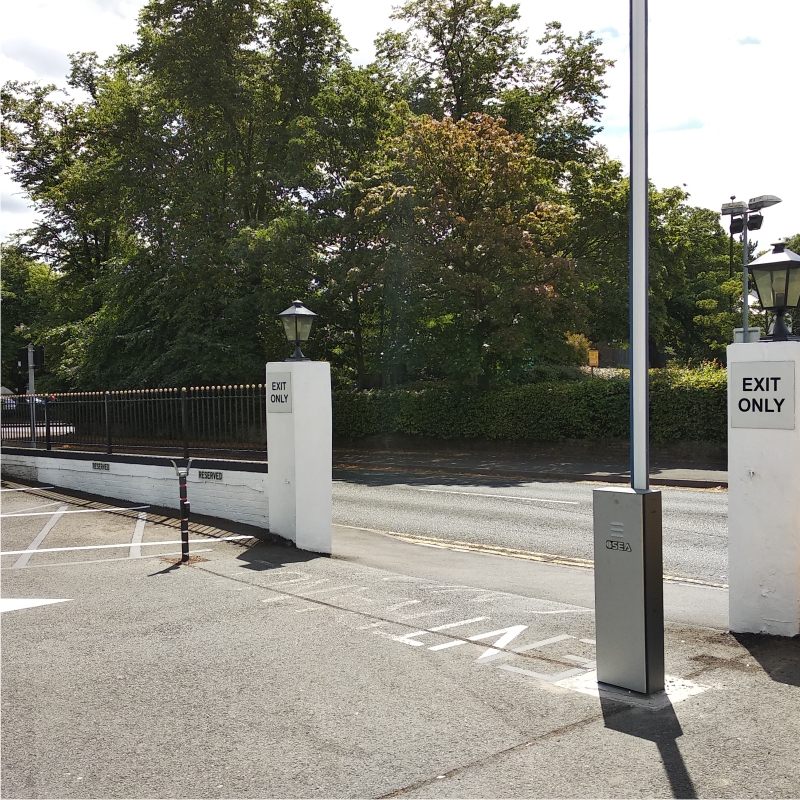
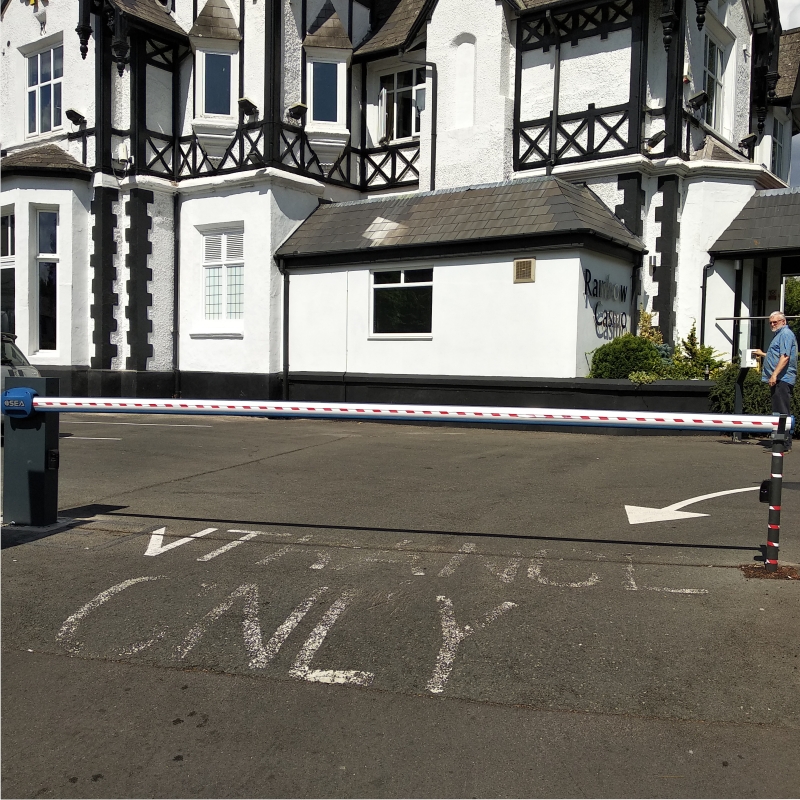
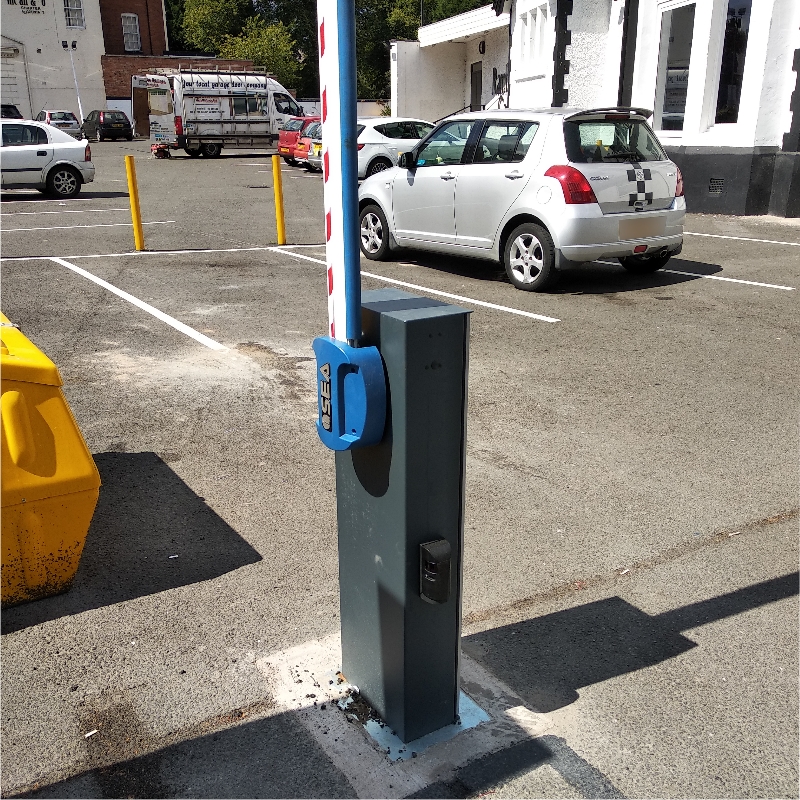
Here at SEA UK we work with some of the most talented installation companies in the country. Today we are on site with Richard the owner of Garage Door Restore West Midlands (GDR) and his team. They have recently completed a traffic management system for a Casino in Birmingham. GDR’s customer required an entrance and exit barrier that could cope with the 24 hour demands of the Casino, located near to Birmingham City centre.
The Entrance
It was decided that a vehicle detector would activate the traffic barrier, allowing free entrance to the site. Richard, in consultation with our specification team and the Casino, chose a Storm traffic barrier system. The Storm is the perfect traffic barrier for this site with up to a 7.5m beam and 24V high intensity usage motor, capable of near continuous operation.
Richard has set the traffic barrier back from the road to make room for the loop detector and added new railings with brick pillars to further control traffic flow. The 24V motor on the Storm provides in built current sensing safety and low heat build up when in continuous use. In this case the 7.5m beam was not needed and a 6m beam was used instead. Finally a pair of Photo 60 anti vandal photocells were added for additional pedestrian safety. Security was increased by fitting a magnetic lock at the end of the barrier, securing the beam against the fork support when in the closed position.
The Exit
For the exit traffic barrier a Sprint system was installed instead of the Storm, as the barrier length required did not exceed 5m. The Sprint Electro-hydraulic system allows for continuous operation with built in current sensing and limit switches for automatic learning. Anti vandal photocells and a magnetic lock were chosen again for added vehicle/pedestrian safety and security. A token reader has been sited near the exit barrier preventing unauthorised vehicles from using the car park and leaving unhindered. Car park users now need to obtain a token from inside the Casino to leave the premises.
Richard from GDR West Midlands says, “Our customer needed an automatic gate system to prevent unauthorised use of their car park and the SEA traffic barriers are the ideal solution.” He goes on to say, “The support SEA have provided has helped keep our costs down and get this job finished on time and on budget.”
For more information about this automatic gate system or one like it, contact our technical sales and specification team on 0121 433 3348. To be put in touch with a local SEA installer like Richard fill in our contact form here.
We are sad to report that earlier this year Five Counties Automation decided to close their operation. If you have been trying to contact Five Counties on 01827 717555, sales@fivecountiesautomation.co.uk or are no longer getting a response from their website www.fivecountiesautomationltd.com this will be the reason. SEA UK was a long term supplier for Five Counties and we have extensive knowledge of the products they supplied.
Formally located on Unit 20 Innage Park, Abeles Way, Holly Lane Ind Estate, Atherstone, CV9 2QZ. Five Counties Automation where experts in fitting a variety of electric gate systems. Throughout their 30 year run Five Counties provided SEA automated systems to Rock Stars, major businesses, government institutions and of course many private households across the country. At every stage SEA UK and Five Counties shared their experience and expertise in tackling every challenge associated with the installation and maintenance of automatic gate systems.
In fact SEA UK and Five Counties have more in common then just their equipment, as SEA UK’s Managing Director Jof Reynolds was a joint owner in Five Counties for nearly 20 years, before leaving to take over ownership of SEA UK. Today Jof and the rest of the team at SEA UK wish everyone at Five Counties Automation the very best for the future.
Once again, if you have been trying to contact Five Counties on 01827 717555, sales@fivecountiesautomation.co.uk or via their website www.fivecountiesautomationltd.com and have a Five Counties Automation installation, we can offer you assistance; please feel free to contact us. Although SEA UK is a trade wholesaler we have a wide network of expert installers nationwide who are ready to help you maintain any gate or intercom installations.
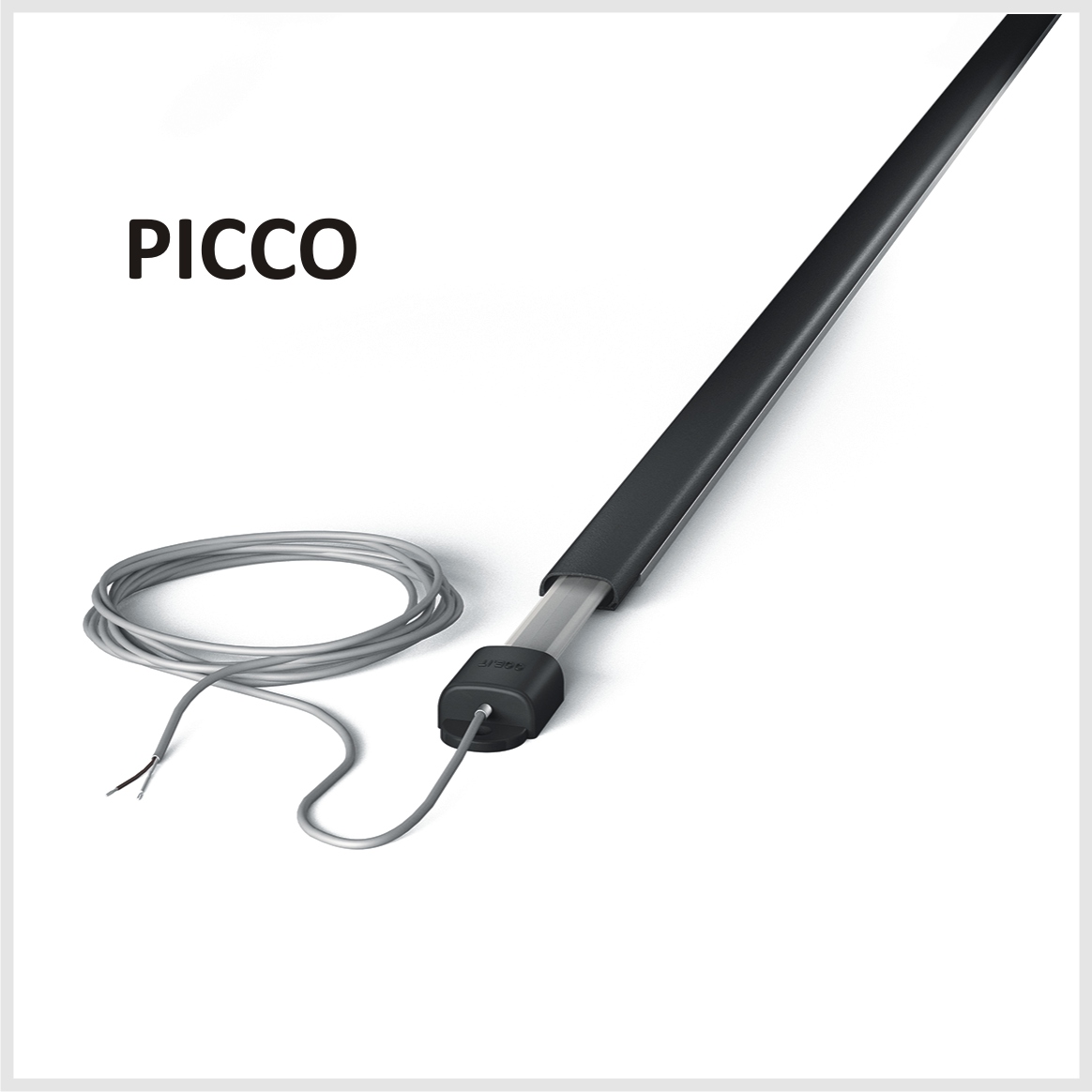
SEA UK is pleased to introduce the MiniCND and the PiccoCND 8K2 resistive safety edges to our range! Both edges provide advanced stop and reverse safety to new and existing gate systems, but now with a much smaller profile.
The MiniCND is similar in appearance to the CompactCND but is in fact around 20mm thinner with a total profile size of only 43mm. This narrow profile makes the edge ideal for swing gate systems. As with other edges in the range the Mini can be cut down to the correct size quickly on site, making installation of this edge very quick. Like other safety edges in our range the Mini and Picco can be cut down to any size in a matter of minutes, on site. Allowing installers to quickly retrofit an existing gate with an EN12453 compliant safety system on the first visit.
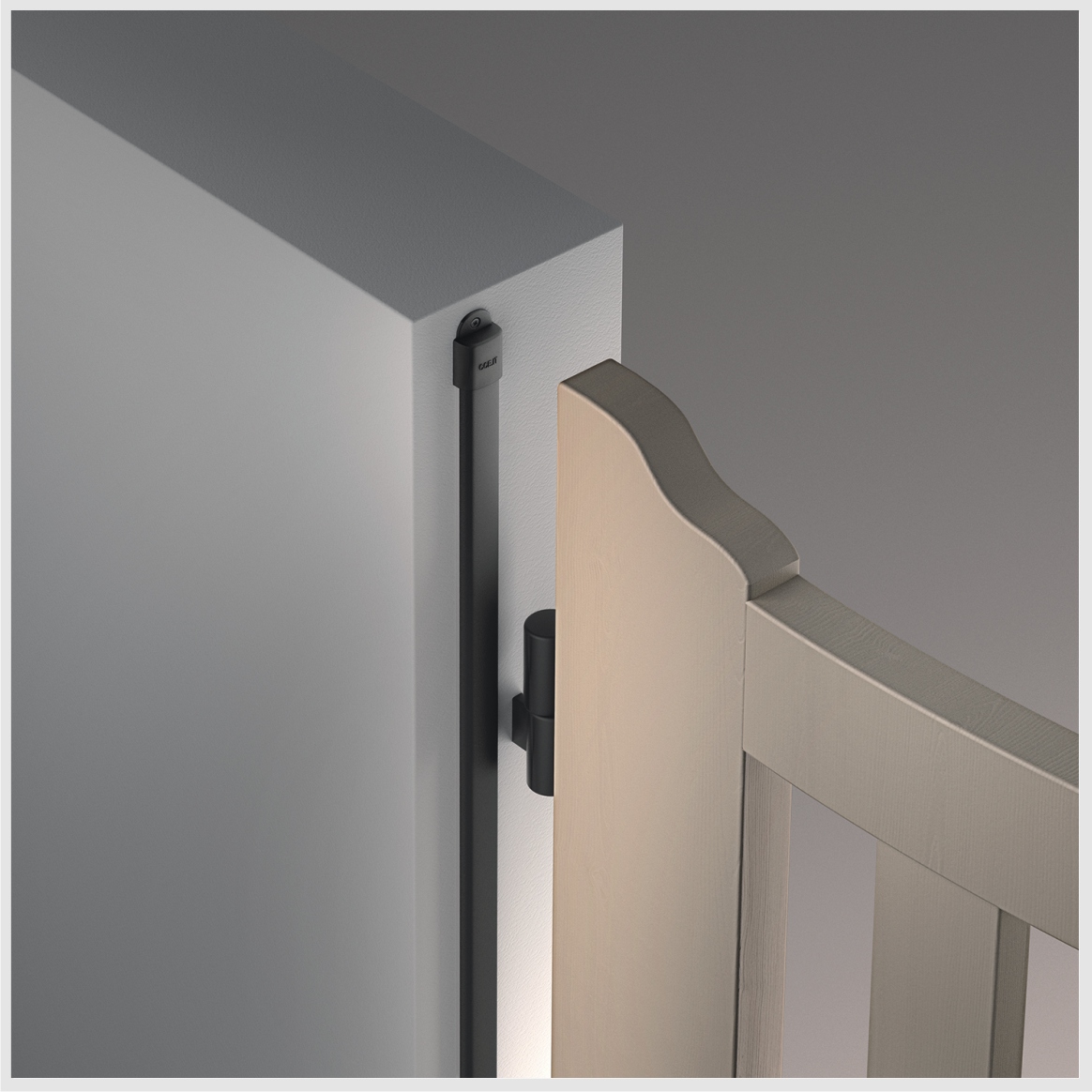
The PiccoCND is the ultimate slimline safety edge with a profile of only 15mm. The Picco’s small size means it can be inserted into hinge gaps, attached to the bottom of gate leafs or fitted to walls and posts. This makes the Picco an excellent choice on swing gates, for use in tandem with the MiniCND. For sliding gates, we recommend using the existing CompactCND, MultiCND and MaxxiCND edges, which have more foam to absorb fast moving, head on impacts.
All our safety edges have been designed from the ground up, to help you reach EN12453 compliance standards on any electric gate system you install. More over our edges can be cut to size on site and fitted in a matter of minutes. If you are a gate engineer or installer contact us today for a quotation!
As a nationwide wholesaler we have formed strong partnerships with local tradesman across the country. If you are searching for help fitting a new gate system or would like to upgrade the safety on an existing system we can help you find a qualified local fitter, contact us to find an installer.
SEA UK are proud to continue supporting the DHF in raising gate safety awareness for Gate Safety Week 2017. We are committed to improving gate safety standards across the automatic gate industry and have enjoyed a strong working partnership with the DHF in several areas.
Clarification of Health and Safety Laws SEA UK has worked closely with the DHF to help clarify laws and form clear best practice guidelines for DHF members and gate installers to follow. SEA UK have listened to installation companies and work with the DHF to find the best equipment and the best practices to meet every day safety challenges. The DHF have been invaluable in providing clarity for Health and Safety laws!
Continued free training SEA UK are committed to helping all installation companies achieve the highest health and safety standards. Over the last 12 months, SEA UK have run dozens of free training sessions and workshops focused on gate safety theory and best practice. All sessions are run by DHF trained members of staff and will give an excellent base of understanding for those seeking to undertake the DHF’s own training program. Contact us to find out more information about gate safety training.
Handover documentation SEA UK has released a new handover document which helps guide installation companies through the safe commissioning of a gate system. Support and guidance offered by the DHF was of great help while making this well received document.
SEA are constantly striving to bring new safe gate systems to the market; to that end the company has made the Position-Gate. This device will enable Mini Tank and Half Tank systems to accurately “feel” where the piston rod is, while the gate is travelling open or closed.
By sensing the exact position of the piston rod, the Position-Gate knows where the gate leaf is in it’s travel, how fast it is moving and precisely when it will encounter a physical stop. Therefore, the Position-Gate can be used as an auto learn device and a stop and reverse safety device. It can also operate below the 50mm threshold, where traditional current sensing devices and encoder systems do not work effectively.
SEA UK Position-Gate Force Test Results.
At SEA UK we periodically tests our product range to ensure the highest standards of reliability are maintained. While testing the Position-Gate we carried out a series of Force Tests to confirm the Position Gate worked as intended.
The Gate.
These tests were performed using our repaired motor test gate; if you sign up to one of our free training courses, you will be working with this gate. Our test gate is 2.5m long, weighing approximately 280kgs when fully loaded. To better simulate site conditions, the gate has standard eyelet hinges, with weight added to the front of the gate leaf to increase momentum and loading on the motor. The motor is connected to a central beam which is unsupported by vertical bars. This is an intentional design to simulate common flexing found in many site situations. The operator used is a Half Tank 100, 270mm piston stroke, 230V AC motor. The control system is a Gate 2 DG, 230V control panel.
SEA Test Gate 2.5m long & 280kgs in weight.
SEA Test Gate With Half Tank 100 motor
Testing 2.5m Gate Leaf, Weighing 280kg.
When force testing a gate system, measurements must be taken at the bottom, middle and top of the gate leaf; as well as at different distances away from the close stop position. The diagram below shows where these tests are made and provides a useful numbering system to match up with the results later.
Test Position 8
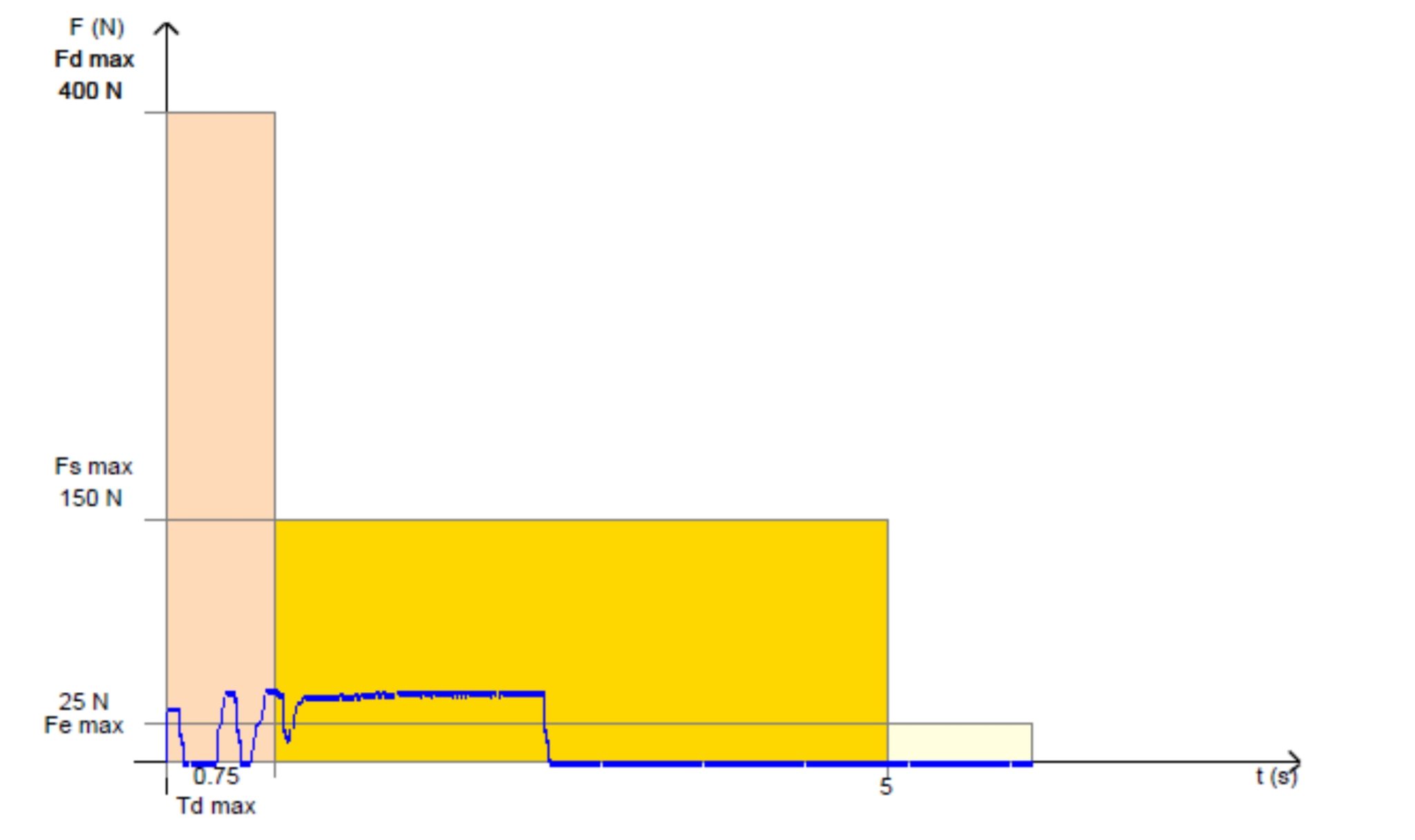
The first test is typically carried out in position 8, the gates centre, at 500mm from the close stop position. At this point the gate leaf has entered slowdown and is moving at roughly half speed; our gate has no safety edges or other forms of cushioning to absorb the impact.
Point of Measure
Description of tests
Fd [N] -Measure – Limit
Td [s] – Measure – Limit
Fs [N] – Measure – Limit
Fe [N] – Measure – Limit
Result
8
Height: at the center of door, or 2500mm above the floor, when the height of door is >5000 mm. Gap: 500mm from main closing edge and the opposing edge.
119/400
0.00/0.75
24/150
0/25
PASS
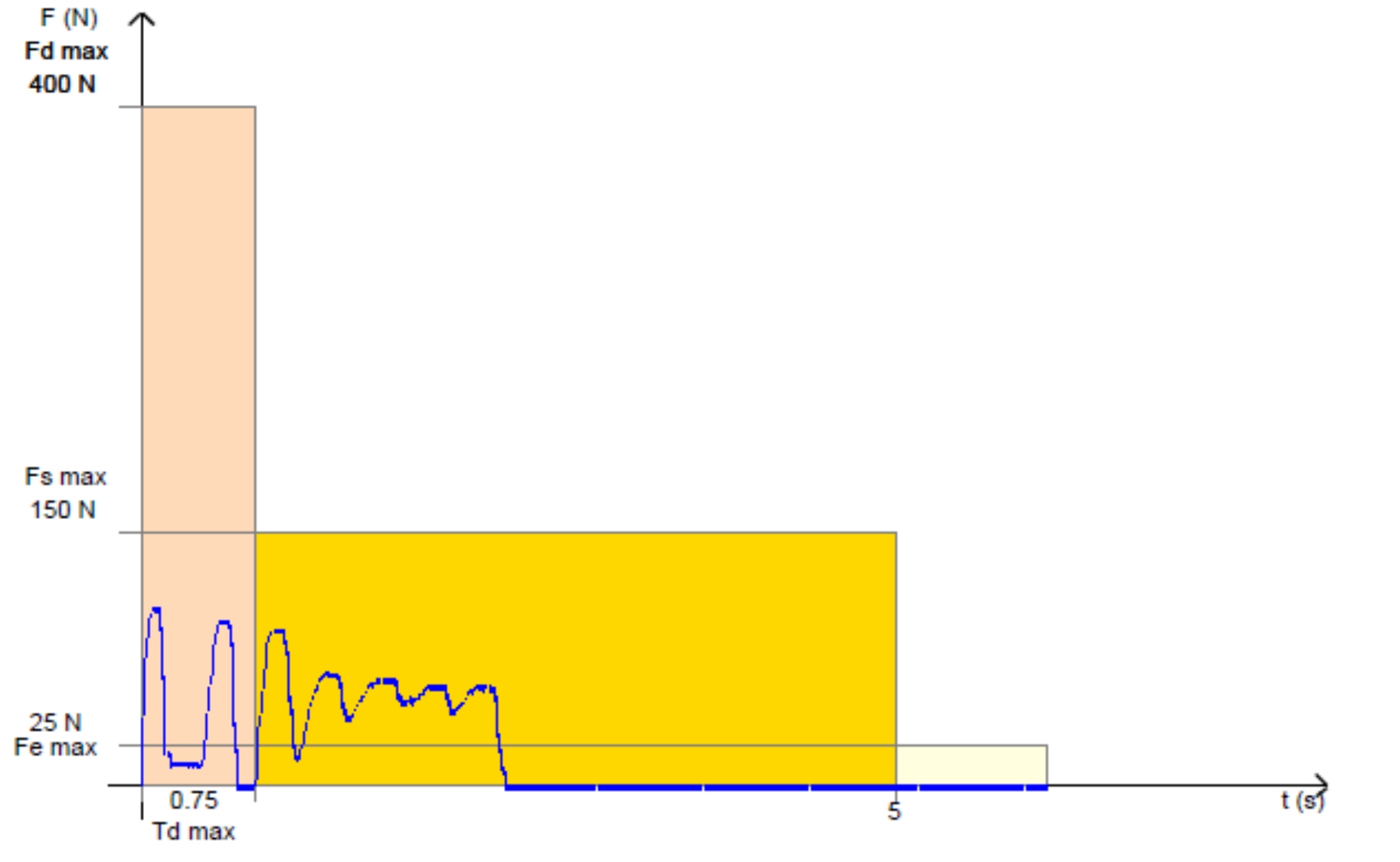
The results above show a PASS has been achieved, but more information can be seen from the force graph produced by Microtronics Blue Force software. The initial impact is detected very quickly and the gate starts to reverse. The excess weight added to the gate leaf and the lack of central vertical supports on our test gate creates a wobble, this can be seen by the waves in the graph. As the gate moves away from the tester the waves diminish, before falling to 0 as the gate fully clears the tester. The gate is moving away from the obstructions within approximately 2.0 seconds.
This PASS is possible because the Position-Gate knows the precise position of the piston rod. The control panel knows that the gate is within the gate slowdown phase (the 500mm danger area) and is expecting lower momentum with pushing forces adjusted below the 150N threshold. It can therefore accept a longer reverse time allowing for wind slowdown at lower forces.
Test Position 10
Test are not often performed at 1m distance because the motors are moving at full speed. Many systems especially current sensing versions, struggle to pass at this distance due to site conditions and motor reaction times.
Before carrying out the force test SEA engineers perform a separate test to simulate site conditions and the effects of wind on the gate. With default pressures used on the Half Tank our engineers added a 90N (9kg) resistance to the gate. As expected the motor continued to open and close with this added resistance.
Next, with the same pressures, the resistance removed and the gate travelling at full speed again, our engineers carry out the Force Test. A clear PASS is recorded and it would even be possible to increase motor pressures for the Half Tank operator to cope with increased wind loadings if necessary.
Point of Measure
Description of tests
Fd [N] – Measure – Limit
Td [s] – Measure – Limit
Fs [N] – Measure – Limit
Fe [N] – Measure – Limit
Result
10
Height: at the center of door, or at 1000 mm above the floor. Gap: 1000 mm from main closing edge and the opposing edge.
372/1400
0.59/0.75
12/150
6/25
PASS
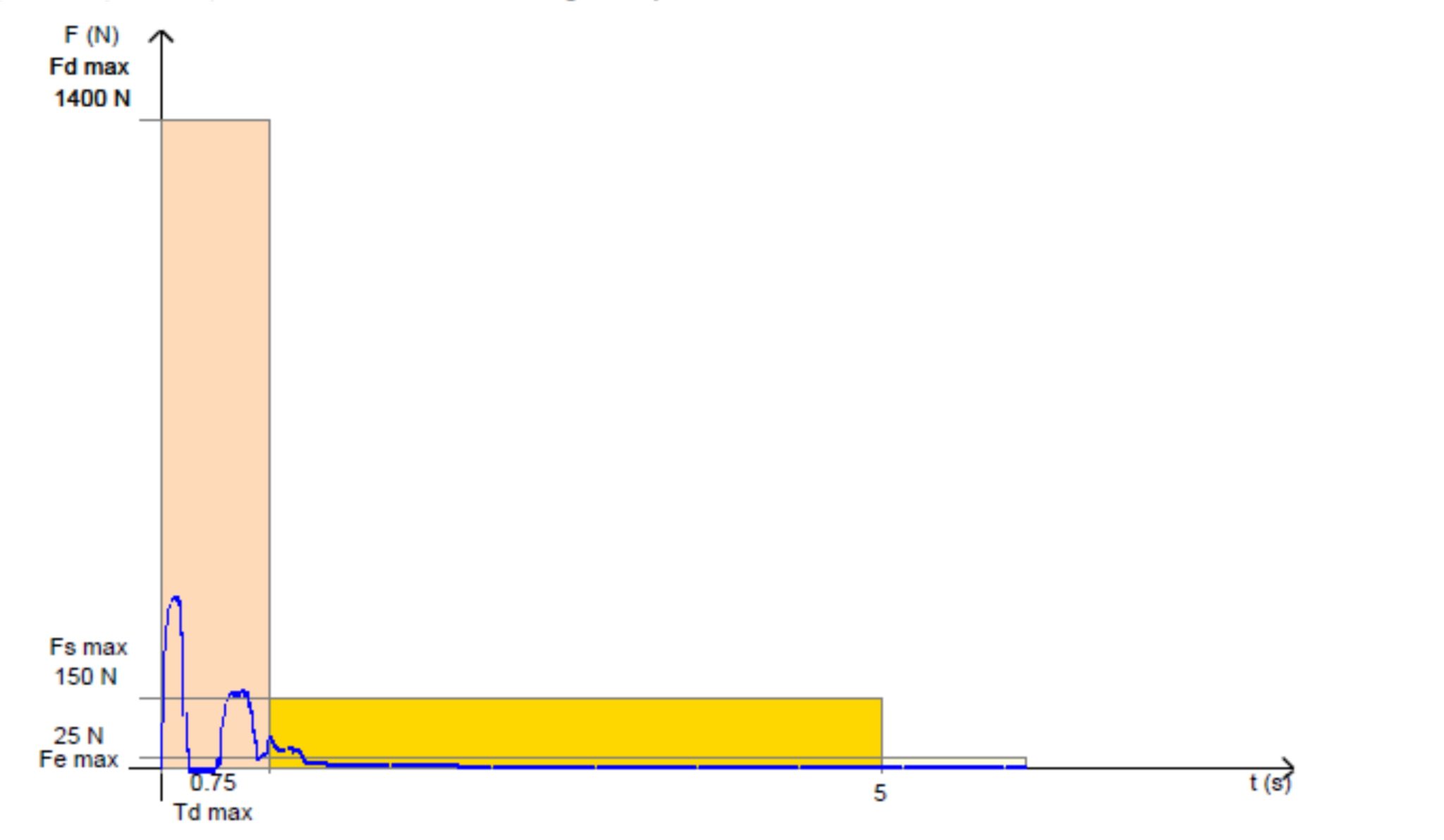
As we can see form the table above and graph below the Position-Gate allows the system to pass the test. Once again, a small bounce is recorded due to the style and construction of the gate, as well as the added weight at the end of the gate leaf.
Test Position 1
More tests are carried out at positions 1 and 2. Here again there is a small wobble due to the excess weight, our testers have added to the gate but importantly the Position-Gate has slowed the motor down ready for the gate to meet the physical stop. This means the initial impact is just above the 25N Fe mark.
Point of Measure
Description of tests
Fd [N] – Measure – Limit
Td [s] – Measure – Limit
Fs [N] – Measure – Limit
Fe [N] – Measure – Limit
Result
1
Height: at 50 mm from bottom edge of the door. Gap: 50mm from main closing edge and the opposing edge.
51/400
0.00/0.75
18/150
0/25
PASS
Many encoder and current sensing systems must switch off at distances around 50mm or risk recording a false positive, but the Position-Gate continues to operate up to the physical stop position. This can render other systems ineffective at protecting the small closing gaps at the end of a gates travel. The Position-Gate measures the position of the motor ram switch off distance, which can be accurately and electronically adjusted; resulting in a passed force test.
Our engineers report that when the motors are set up to use low pressure, the impact force of the closing gate is below 25N (not registering on the Force Tester). This would not be recommended on site as it would cause reliability issues. It does however, underline the fine control which can be achieved with the Position-Gate system and reliable hydraulic operators.
Position-Gate Qualities
When considering gate safety products, it is important to understand the relative qualities of each product. The Position-Gate may not be the perfect solution for every site. For example, a very long gate leaf reduces the effectiveness of the system. A close boarded gate can act like a sail; the motor pressures may need to be increased to provide reliability, resulting in the FS Max being above 150N. Furthermore, certain areas of a gate such as the hinge area and curb crushes could still be dangerous and need protecting.
Summary
The Position-Gate is a powerful new tool for SEA hydraulic electric gate systems and will lead to improved safety on many sites. It can pass force tests at all locations allowing the adjustment of the motor power to suit site conditions. However, it should be used in conjunction with a proper risk assessment and other safety devices such as Safety Edges, Photocells, and Hinge Guards.
SEA UK are pleased to announce that at last the upgraded Hinge Guards are available! Hinge Guards are simple products designed to protect the hinge area of manual and automatic gates. They are a cost effective and reliable way to protect the hinge area and thus help a gate meet the necessary Health and Safety standards for automatic gates in the uk.
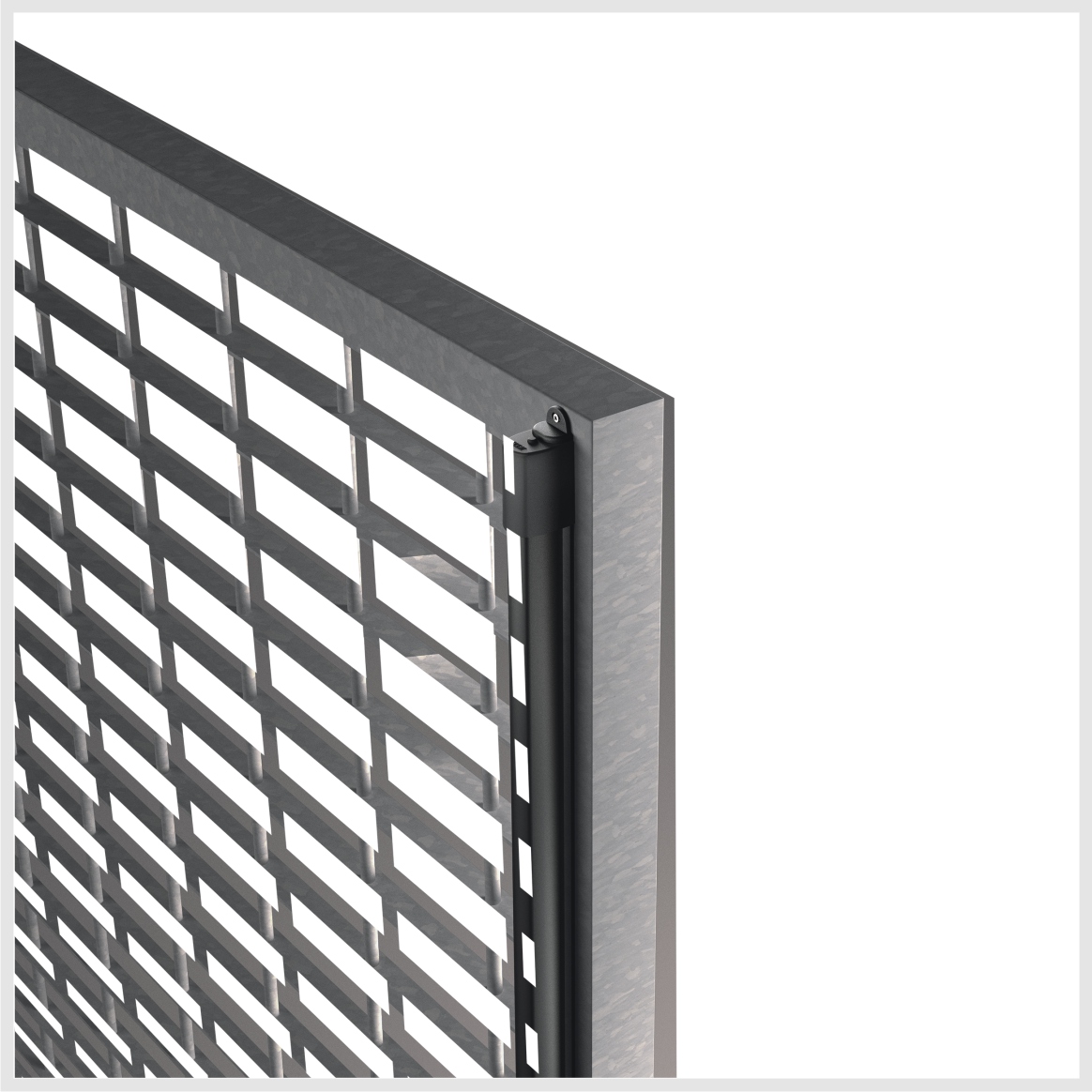
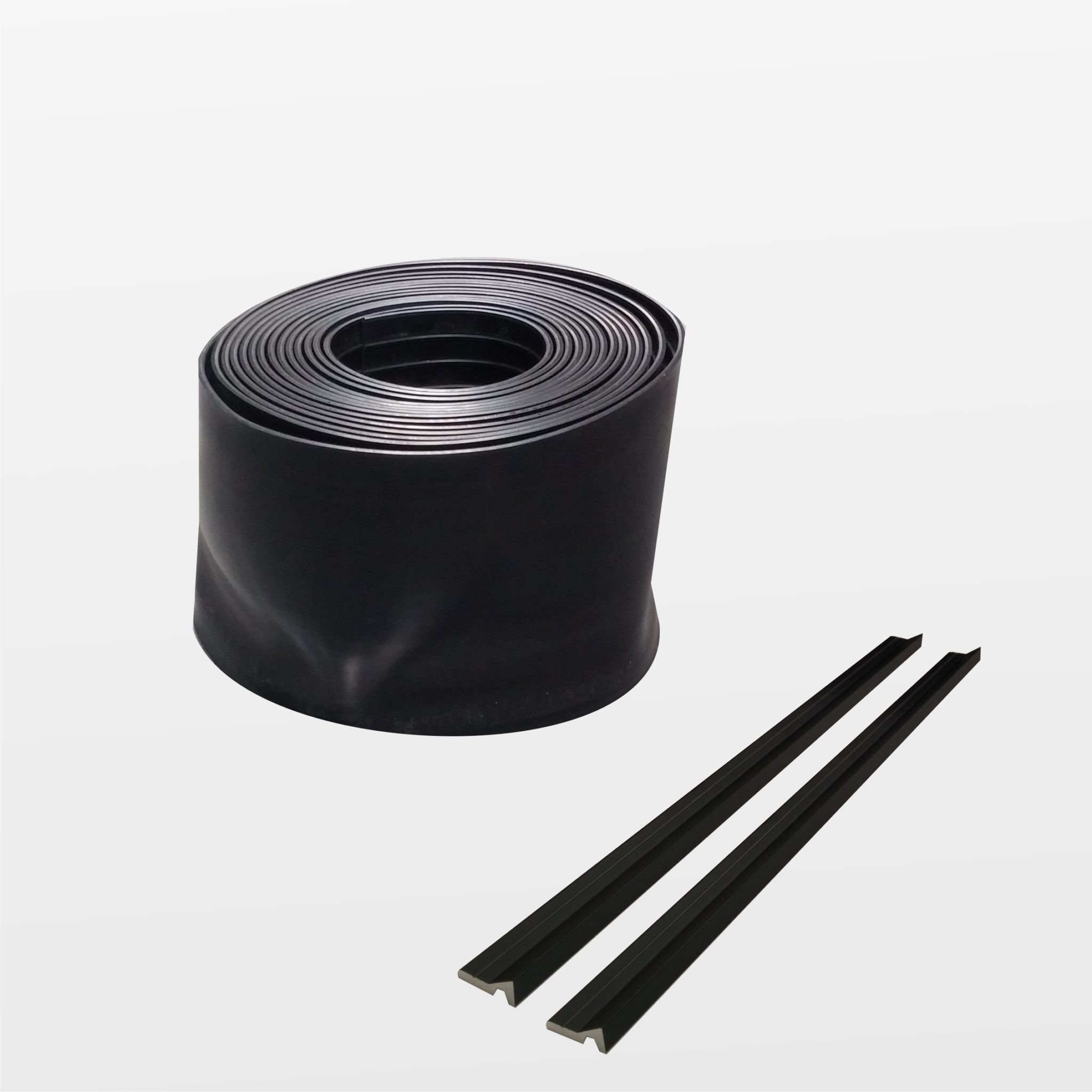
The product consists of a long rubber extrusion designed to weather extreme hot and cold temperatures without weakening, tearing or becoming brittle. Each length of rubber is attached to the gate and the post by an aluminium fixing which clamps the rubber in place.
As SEA strive to continuously improve our products and services we have listened to our customers feed back and can now supply the aluminium fixing strips in a black anodised finish. This discreet new look will compliment the gate system while improving the safety for all users.
For more information on the Hinge Guard or to place an order please contact us on 0121 433 3348.
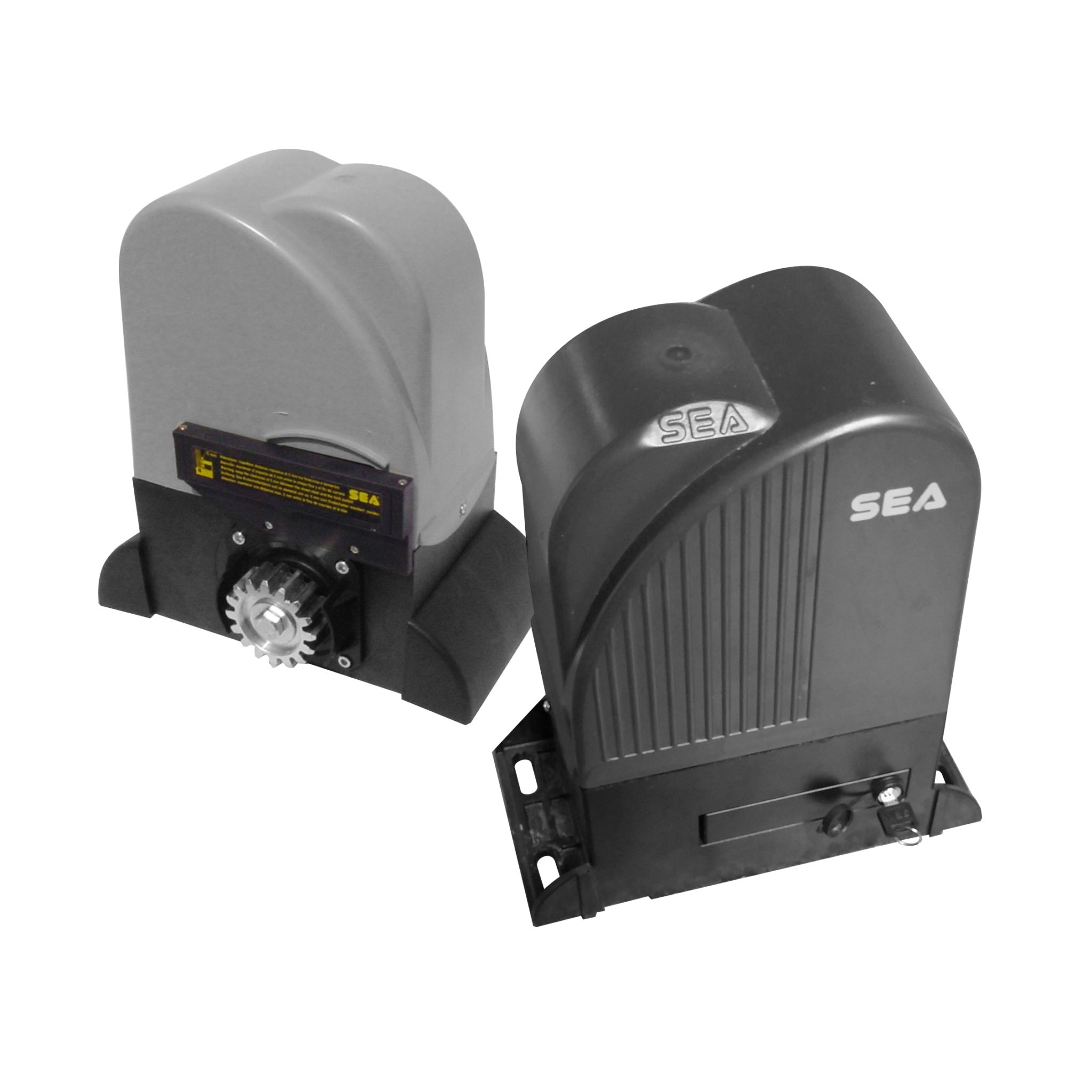
LEPUS motors have been the main stay of SEA’s Sliding Gate range for almost 20 years. The latest versions (the 600 and 1600) incorporate a top of the range Gate 1 DG control panel, advanced safety systems and SEA’s most robust build quality yet.
From the beginning SEA envisioned the Lepus as a tough work horse motor which would have a gear box capable of meeting the heaviest sliding gate requirements. The gear box for the Lepus contains machined steel components, high quality bearings and oil lubrication through out. In fact, the Lepus 600 and Lepus 1600 share the same gear box as their larger brother the Three Phase Lepus 2000, resulting in a Lepus 600 having a gear box so strong that it has been rated to drive a 2000kg gate.
Today however, it is not enough to simply be able to drive a heavy load. A reliable gate motor must also be capable of working on busy sites, with a high number of operations each day. To ensure SEA motors can stand up to the rigour of real site conditions, the motors were destruction tested while carrying their maximum loads. SEA uses this data to calculate their duty cycles; you can be confident that the Lepus will perform as specified for more than the 2 year warranty, which could include as many as 400,000 operations!
When asked for a comment David Hardwick, the Head of SEA UK’s Technical team said, “We haven’t had a LEPUS motor returned in 3 years; since I’ve been working here we have only had 1 come back because it was installed without limits and without programming!” David goes on to say, “As a sliding gate system, the Lepus outperforms everything we have seen, even motors rated at 2000 kgs. We have found the Lepus can match them under practical site conditions and the best thing is, the motors are 230V. You always have the power there if you need it and all the safety systems work with the motor still at full power. Our customers tell us its easy to use, easy to work with and totally reliable.”
Our technical sales team is ready to answer all your questions on the Lepus. Feel free to ask us about specification, and technical requirements, we are also happy to provide advice and guidance on installation best practices and gate safety. Just head to our contact page to get in touch.
Over the past 12 months SEA UK has achieved some remarkable things with our customers and partners. We are really proud of these stats, but we aren’t resting and are working heard to beat them next year! One of the reasons we records such low product failures is arguably due to the high level of training and technical support provided to the installation companies we work with. SEA UK has continued to provide a bespoke training program which is tailored to each company’s needs. Any gate installation company can enjoy the benefits of our training, sign up HERE for a free session!
Comply with gate safety laws & use SEA’s handover document: SEA Handover Doc
SEA has been championing the highest gate safety practices since our company formed. We were one of the first companies to offer a dedicated safety edge contact for our control systems and have been recommending safety edges be fitted as standard for over a decade.
Today SEA are active members of the Gate Safety community and hold certifications in gate safety with the DHF (Door and Hardware Federation) as well as Gate Safe. We hold regular personalised training sessions helping gate installation companies across the country understand the regulations and find practical solutions to common safety concerns associated with electric gates.
At the request of our customers we have created a Handover document containing guidance on gate risk assessment, how to CE mark a gate system as well as important information for end users. While it is impossible to conceive of every eventuality, the SEA handover booklet provides a clear starting point for the installer.
Bespoke PDF versions of the handover document are available on request to account customers. When asked about why SEA had taken the step to produce the document Managing Director Joffre Reynolds said, “We always strive to give our engineers and customers the best service and equipment possible. The handover document will assist the smaller companies to enable them to fit safe and compliant gate systems more confidently.”